Docs
  • Solver
  • Models
    • Field Service Routing
    • Employee Shift Scheduling
    • Pick-up and Delivery Routing
    • Task Scheduling
  • Platform
Try models
  • Timefold Solver SNAPSHOT
  • Framework integrations
  • Edit this Page

Timefold Solver SNAPSHOT

    • Introduction
    • Getting started
      • Overview
      • Build as a service
      • Embed as a library
        • Hello World guide
        • Quarkus guide
        • Spring Boot guide
    • Domain modeling
      • Guide
      • Building blocks
      • Common patterns
    • Constraints and score
      • Overview
      • Score calculation
      • Understanding the score
      • Load balancing and fairness
      • Performance tips and tricks
    • Running the Solver
      • Overview
      • As a service
        • REST API
        • Model Enrichment
        • Constraint weights
        • Demo data
        • Exposing metrics
      • As a library
        • Configuring Timefold Solver
        • Constraint weights
        • Quarkus integration
        • Spring Boot integration
        • JPA/JAXB/JSON integration
    • Diagnosing the Solver
      • Benchmarking
      • Solver diagnostics
    • Optimization algorithms
      • Overview
      • Construction heuristics
      • Local search
      • Exhaustive search
      • Custom moves
        • Neighborhoods API
        • Move Selector reference
    • Responding to change
      • Continuous planning
      • Real-time planning
      • Non-disruptive replanning
      • Assignment Recommendation API
    • Example use cases
      • Vehicle routing (guide)
      • More examples on GitHub
    • FAQ
    • New and noteworthy
    • Upgrading Timefold Solver
      • Upgrading Timefold Solver: Overview
      • Upgrade from Timefold Solver 1.x to 2.x
      • Upgrading from OptaPlanner
      • Backwards compatibility
      • Migration guides
        • Variable Listeners to Custom Shadow Variables
        • Chained planning variable to planning list variable
    • Commercial editions
      • Overview
      • Installation
      • Performance improvements
      • Score analysis
      • Recommendation API
      • Nearby selection
      • Multithreaded solving
      • Partitioned search
      • Constraint profiling
      • Multistage moves
      • Throttling best solution events

Framework integrations

1. Overview

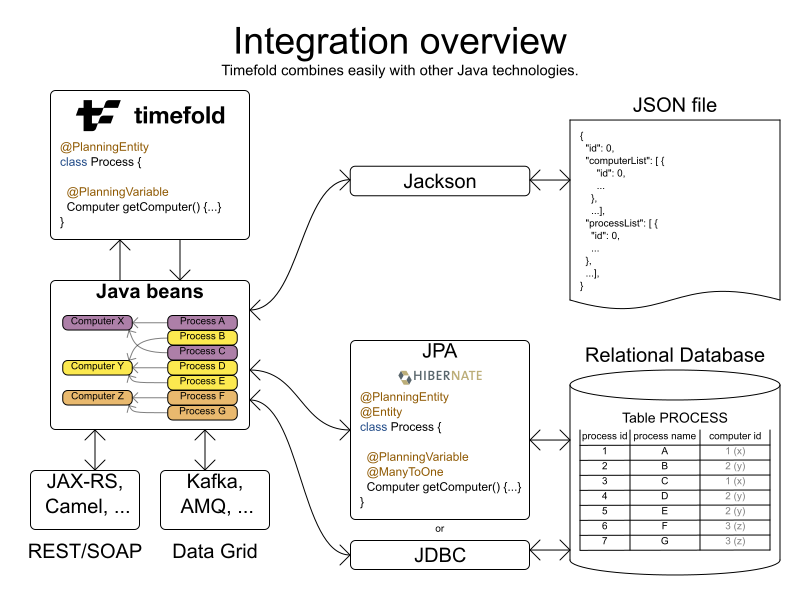
Timefold Solver’s input and output data (the planning problem and the best solution) are plain old JavaBeans (POJOs), so integration with other Java technologies is straightforward. The most common way to use Timefold Solver is through its first-class framework integrations: Quarkus and Spring Boot.

Beyond that, Timefold Solver also integrates with many other Java technologies. For example:

  • To read a planning problem from the database (and store the best solution in it), annotate the domain POJOs with JPA annotations.

  • To read a planning problem from an XML file (and store the best solution in it), annotate the domain POJOs with JAXB annotations.

  • To expose the Solver as a REST Service that reads the planning problem and responds with the best solution, annotate the domain POJOs with JAXB or Jackson annotations and hook the Solver in RESTEasy or a similar framework.

While it is possible to annotate the same domain classes with both Timefold Solver and persistence or serialization annotations, this tightly couples your planning domain to your data model. In many applications it is preferable to keep them separate, for example, by mapping between a persistence entity and a dedicated planning model so that changes to one do not force changes to the other.

integrationOverview
  • © 2026 Timefold BV
  • Timefold.ai
  • Documentation
  • Changelog
  • Send feedback
  • Privacy
  • Legal
    • Light mode
    • Dark mode
    • System default