Introduction
Every organization faces planning problems: providing products or services with a limited set of constrained resources (employees, assets, time, and money). Timefold Solver is a lightweight, embeddable constraint satisfaction engine that optimizes these problems to do more business with fewer resources.
|
This documentation provides guidance on using our open-source solver to build custom models from scratch. For common planning problems, we also offer ready-made models that can be seamlessly integrated via our REST API. Explore our documentation and available models here |
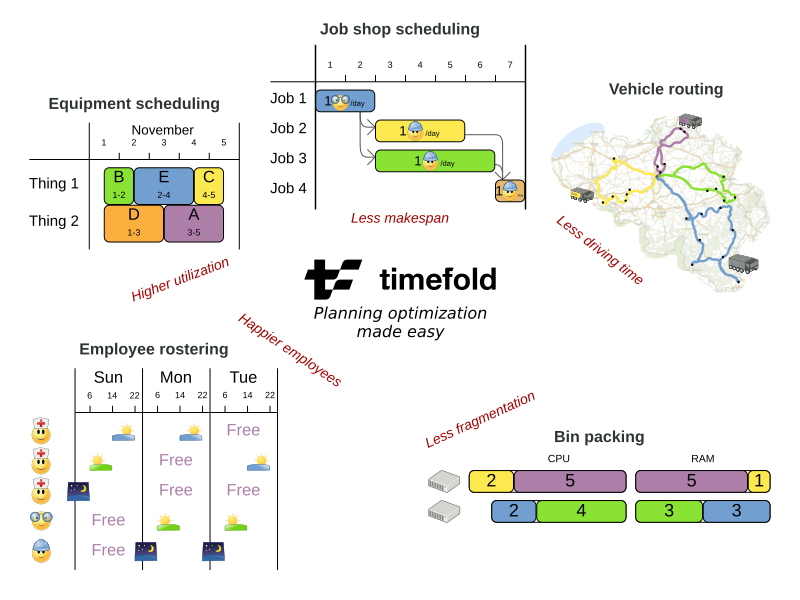
1. Planning problems
A planning problem arises from a need to achieve a goal by organizing available resources under a set of constraints:
-
Building a house, where workers and materials are the resources, and construction order and site hours are the constraints.
-
Staffing a hospital shift, where qualified personnel are the resources, and working hour rules and required specializations are the constraints.
-
Routing delivery vehicles, where vehicles and drivers are the resources, and time windows, capacity, and distance are the constraints.
Planning problems grow combinatorially as resources and constraints are added. Even a small field service problem with 4 vehicles and 8 visits produces over 19 million possible assignments for a brute-force algorithm to consider. Timefold Solver evaluates this space efficiently, finding good solutions in a fraction of the time it would take to do manually.
2. Constraints
Constraints can be classified as hard, medium, or soft:
-
Hard constraints are rules that must not be broken — for example, an employee can only be in one place at a time, or dependent tasks must complete in order. Violating a hard constraint produces an infeasible plan.
-
Medium constraints apply when resources are scarce — for instance, assign as many customer visits as possible when there aren’t enough technicians to cover all of them.
-
Soft constraints express business preferences — minimize travel time, assign employees to preferred shifts, and similar goals.
Solutions are scored to reflect how well they satisfy these constraints.
For example: 0hard/-257medium/-6119520soft.
A solution with zero hard constraint violations is always considered better than one that breaks even a single hard constraint, regardless of the soft score.
3. Technology
Timefold Solver is 100% pure JavaTM and runs on Java 21 or higher, on any JVM platform. It integrates natively with Quarkus and Spring Boot, and supports Kotlin.
You can use it to build an optimization service, or embed it into your software as a library.
Next
-
Follow the Quickstart to tackle your first planning problem.